
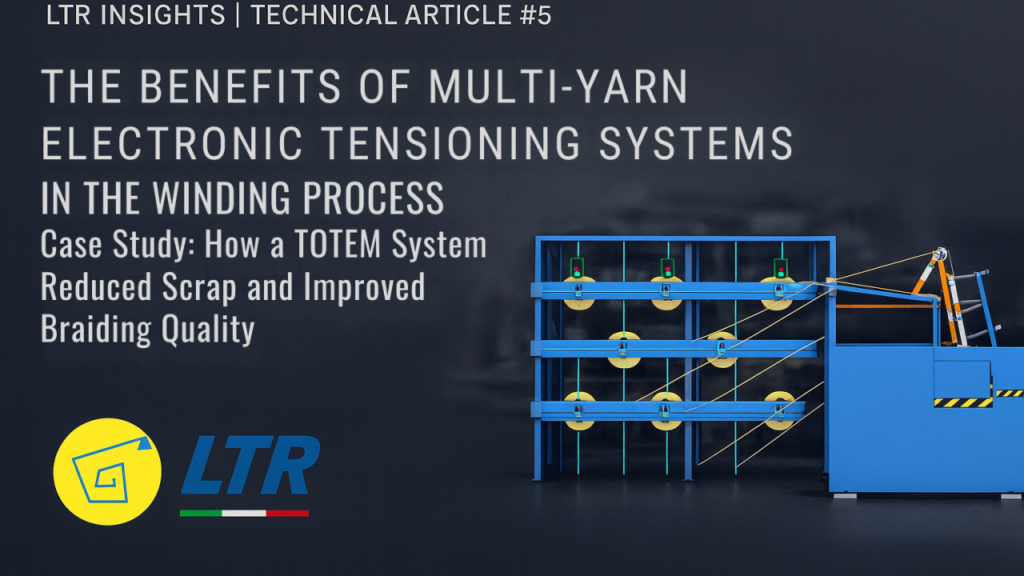
Article #5
1 December 2025
Case Study: How a TOTEM System reduced scrap and improved braiding quality in automotive industry
Introduction
In many industrial winding operations, especially in the preparation of yarn bobbins for braiding, tension stability plays a decisive role in product quality.
In this edition of LTR Insights, we present a real case study where a traditional winding station equipped with no tensioner systems was upgraded to an electronic multi-yarn tensioning system.
The result? A dramatic reduction in scrap, improved stability, and significantly higher process efficiency.
Background: A Process Limited by Tension Variability
Before the improvement, the rewinding station suffered from:
- manual tension adjustment using spring-based tensioners
- readings from a fluctuating tensiometer, highly operator-dependent
- unstable unwinding from cones, causing jerks and filament breakage
- plexiglass separators that damaged the yarn
- inconsistent tension from one position to the next
This instability carried over to the braiding machine, causing frequent defects and significant waste.
According to the production data, 42% of total scrap was caused directly by yarn tension issues.
Identifying the Root Causes
The main contributors to scrap included:
- lack of repeatability in manual tension setting
- mechanical friction that varied over time
- poor unwinding conditions
- variation in yarn length and tension uniformity
- frequent yarn breaks during braiding
These issues made the process unpredictable and costly, both in raw material and in machine downtime.
Introducing a Multi-Yarn Electronic Tensioning System
The improvement project replaced the old setup with a new multi-yarn electronic tensioning system (TOTEM) featuring:
- a closed-loop magnetic brake
- a load cell for real-time tension measurement
- automatic adjustment to maintain a user-defined tension set point
- tension-based machine stop when values fall outside tolerance
- redesigned creels using plastic cones to eliminate friction
Every winding position now works with identical, continuously monitored tension levels.
Results and Benefits
After the upgrade, the process showed immediate and measurable improvements:
Before
- operator-dependent tension
- high variability between positions
- jerks and filament damage during unwinding
- inconsistent bobbin formation
- braiding defects
- high scrap percentage
After
- automatic, repeatable tension setting
- stable unwinding thanks to friction-free cones
- predictable, uniform bobbin structure
- reduced yarn breakage during braiding
- significant reduction in scrap
Engineering Insight
A multi-yarn electronic tensioning system delivers three essential engineering advantages:
- Uniformity: every position maintains the exact same tension, regardless of wear or friction variations.
- Repeatability: tension no longer depends on operator skill but is governed by a closed-loop algorithm.
- Process Control: the system continually reacts to speed, diameter, and friction changes to keep the tension at the set point.
By eliminating the natural variability of mechanical systems, the TOTEM system ensures the braiding machine receives consistent, stable tensioned bobbins, a key factor in hose quality and dimensional stability.
Conclusion
This case study demonstrates how multi-yarn electronic tensioning systems represent a strategic upgrade for any winding process where uniformity, repeatability, and traceability are essential.
By stabilizing every single wire at the same tension level, these systems eliminate inconsistencies inherent to mechanical setups and drastically reduce scrap, as demonstrated in the braiding case study.
Beyond textile and braiding applications, this technology is equally valuable for electrical wire processing, such as copper and aluminum conductors, where precise and repeatable tension is critical to insulation integrity, dimensional stability, and long-term product reliability.
Multi-wire tension control is therefore not just a productivity enhancer, it is a quality enabler across multiple industries, supporting modern automation, data-driven manufacturing, and next-generation winding standards.
For any production line facing issues such as tension variability, yarn/wire breaks, or operator-dependency, upgrading to an electronic multi-position system represents a clear, measurable improvement with immediate ROI.