
ARTICLE #01
4 September 2025
Welcome to LTR Insights, the new technical series dedicated to exploring key components in the coil winding process. In this first article, we take a closer look at mechanical tensioners with manually adjustable springs and brake, a robust and effective solution still widely used in various industries.
The Role of the Tensioner in Winding
Tensioners are essential for stabilizing the winding process. Their main function is to compensate for variations in bobbin diameter and wire speed, maintaining a constant wire tension.
This prevents defects such as:
- Wire breakage
- Overlaps or loose coils
- Excessive tension that can damage insulation or deform fine wires
A properly adjusted tensioner contributes to better coil quality, higher process repeatability, and reduced downtime.
Working Principle of Mechanical Tensioners
Operating Concept: Mechanical tensioners from LTR use a combination of arms, brake pulley, and manually adjustable springs. The operator sets the desired tension by adjusting spring preload and brake force. As the bobbin fills, the arm compensates for diameter change, ensuring the tension remains within the target range.
Force Balance: Wire tension (Ftension) is countered by the spring/brake force (Fspring), with the following condition:

This prevents tension drop or wire overstress.
Dynamic Behavior: The arm’s inertia plays a key role. If it’s too heavy, it reacts slowly. If it’s too light, it may oscillate, causing tension instability. Some designs include dual springs or passive dampers to improve performance.
The figure below shows the recommended angle for the wire as it exits the arm pulley.
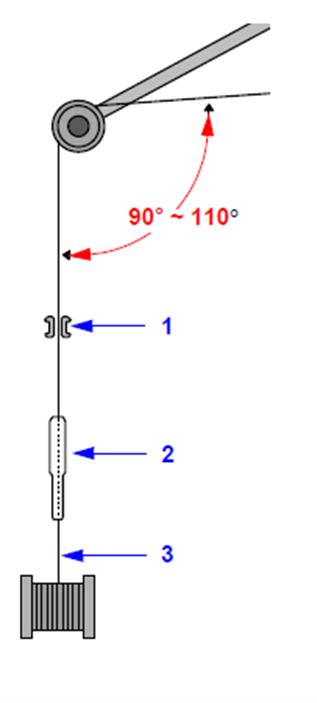
1 = eyelet; 2 = nozzle; 3 = wire
Mechanical Advantages and Technical Characteristics
- Robustness: suitable for harsh environments
- Simplicity: no software, no calibration cycles
- Reliability: constant performance when correctly adjusted
- Maintenance: fast replacement of springs or friction pads
Limitations:
- No closed-loop feedback
- Not suitable for fast-changing tension demands or smart automation
Application Cases
Ideal for:
- Small to medium winding machines
- Stable processes with repeated cycles
- Cost-sensitive environments where reliability is key
- Manual or semi-automatic production lines
LTR Mechanical Series Overview
PLF Series and Typhoon-F2:
- Lateral wire path for space efficiency
- Adjustable brake via arm position
- Excellent tension control even at high speeds
PRA and LEM Series:
- Frontal wire path for compact installations
- High wire recovery and wide tension range
- LEM series gives a wire tension real time overview on its display
Shared Options:
- Wire break detection
- Pneumatic brake release
Process Integration and Technical Influence
Key Process Parameters Affected:
- Surface tension uniformity on coils (N/mm²)
- Consistency of layer winding
- Effective coil volume and shape retention
A wire that is too loose results in unstable coils. A wire that is too tight causes damage and premature failure.
Optimizing Wire Path: Tension is also influenced by the angle of wire entry into the pulleys. Minimizing entry angle and friction improves control. LTR tensioners allow adaptable wire routing (frontal or lateral) to support different machine layouts.
Engineering Insight
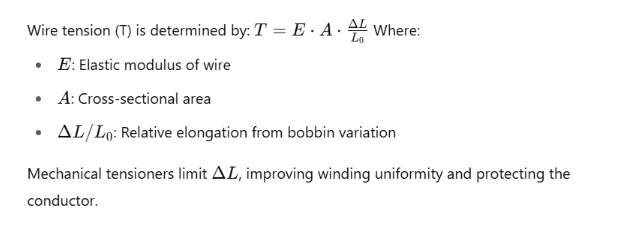
In simpler terms: the tension is higher when the wire is stiffer (higher E), thicker (larger A), or stretched more (larger ΔL). Mechanical tensioners help keep ΔL very small, meaning the wire is not overstressed and the winding remains consistent and uniform.
Conclusion
Mechanical tensioners with manually adjustable springs remain a valid and efficient solution in many coil winding applications. With proper setup, they offer excellent performance, durability, and cost control.