
Article #10
16 September 2026
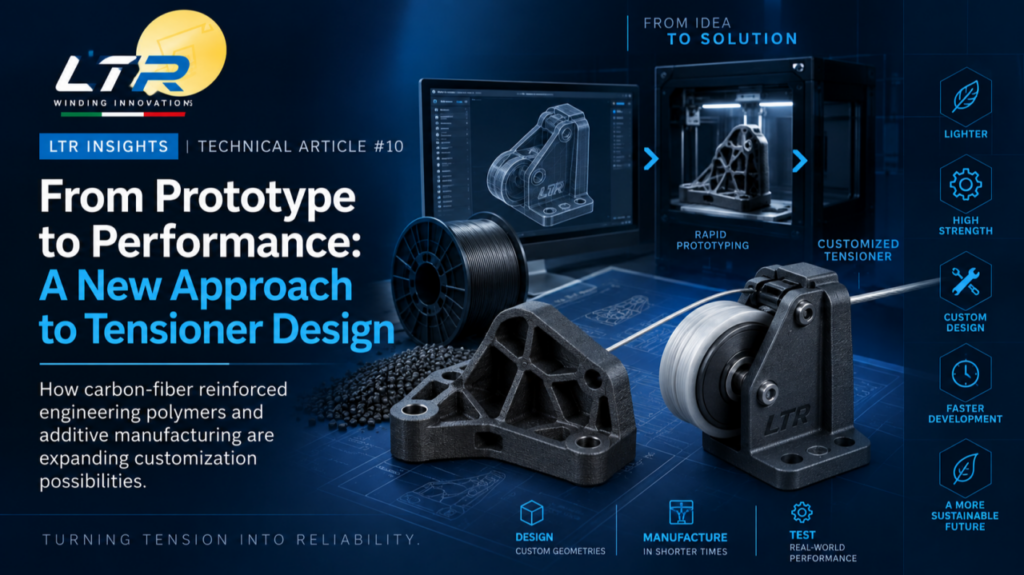
How carbon-fiber reinforced engineering polymers and additive manufacturing are expanding customization possibilities
Introduction
In the previous edition of LTR Insights, we addressed a perception that is still widespread in the industrial world: the assumption that a component made from a polymer material must necessarily be less robust or reliable than one made from metal.
But material selection is only part of the story.
Over the past few months, at LTR we have been actively experimenting with additive manufacturing for the development of tensioner components, testing different materials, geometries, and design solutions.
This process has led us through an interesting evolution. Starting from our first prototypes in ABS, we progressively moved towards carbon-fiber reinforced engineering polymers, which demonstrated greater structural robustness in our prototypes and encouraged us to further develop this technology for new applications.
But perhaps the most interesting result is not the material itself.
Additive manufacturing is changing the way we can design, modify, and customize a tensioner.
From ABS to Carbon-Fiber Reinforced Engineering Polymers
ABS represented an important starting point in our development process.
It allowed us to rapidly explore new geometries, manufacture functional prototypes, and evaluate the potential of additive manufacturing in real applications.
As our experimentation progressed, however, we began working with carbon-fiber reinforced engineering polymers.
In the prototypes developed by LTR, these materials showed greater structural robustness than the ABS solutions initially tested, leading us to select this technology for the development of new tensioner applications.
There is, however, an important point to clarify.
Our objective is not to replace steel or aluminum indiscriminately.
Material selection must always depend on the function of the component, its operating conditions, and the performance required by the application.
The real innovation is having another engineering option available.
It Is Not Just About the Material
When industrial 3D printing is discussed, attention often focuses primarily on the material being used.
From a design perspective, however, one of its most important advantages is something else: the freedom to modify a product quickly.
A tensioner does not operate in isolation. It has to be integrated into a machine, positioned within a specific wire path, and adapted to spaces, mounting points, and configurations that can vary significantly from one application to another.
This is where additive manufacturing becomes particularly interesting.
When the Tensioner Adapts to the Machine
With conventional manufacturing, customizing a mechanical component may require new machining operations, modifications to metal parts, additional setups, and several production steps.
With additive manufacturing, many of these changes can begin directly from the digital model.
This makes it possible, for example, to modify:
- Housing dimensions and overall footprint
- Mounting points
- Supports and bracket geometries
- Integrated seats for components
- Cable routing and other functional features
- The overall tensioner configuration according to the space available on the machine
Once the CAD model has been modified, a new version can be transformed into a physical component, assembled, and tested within a relatively short development cycle.
The principle changes: the machine does not always have to adapt to the tensioner. The tensioner can be designed to adapt to the machine.
From Prototype to Custom Solution
This approach is particularly relevant for LTR because a significant part of our work has always been dedicated to developing custom tension control solutions.
Every winding process can present different requirements:
Wire diameter and material, operating speed, required tension, wire path, available space, machine configuration, and level of automation.
Additive manufacturing can significantly reduce the distance between a specific customer requirement and the possibility of physically testing a proposed solution.
The development cycle can become:
Requirement → Design → Prototype → Test → Modification → New Version
without necessarily waiting for the lead times associated with a new series of custom components manufactured through conventional machining processes.
For custom projects and small production volumes, this flexibility can be particularly valuable.
Faster Development Means More Opportunities to Experiment
There is another important consequence.
When implementing a modification becomes faster, engineers can evaluate more alternatives before defining the final solution.
A geometry can be changed.
A mounting point can be repositioned.
The overall footprint can be reduced.
A component can be integrated differently.
Each new version provides information that can improve the next one.
Additive manufacturing is therefore more than an alternative production method.
It can become an integral part of the product development process itself.
Metal Still Has an Important Role
Discussing engineering polymers and additive manufacturing does not mean that steel and aluminum have become obsolete.
There are components and applications for which metal remains the most appropriate technical choice.
The point is different.
Modern engineering allows us to select the material and manufacturing process according to the application, rather than assuming that a tensioner must necessarily be built using one predetermined technology.
In some cases, the best solution may be metal.
In others, it may involve carbon-fiber reinforced engineering polymers.
And in others, the most effective design may combine both approaches.
Innovation is not about replacing one material with another. It is about having more engineering tools available to design the right solution.
Engineering Insight: Designing for Function
One of the most interesting principles of additive manufacturing is the possibility of designing a component around its function rather than primarily around the constraints imposed by conventional manufacturing processes.
This opens the door to more complex geometries, the integration of multiple functions within a single component, and greater freedom in material distribution.
In a tensioner, this means being able to evaluate different requirements independently:
- Where do we need rigidity?
- Where can we reduce mass?
- Where should a mounting point be integrated?
- Which components need to remain easily accessible?
- How can we adapt the system to the customer’s wire path?
Material selection therefore becomes part of a broader design strategy.
Conclusion
Our experimentation with additive manufacturing began with the exploration of new materials, but it is leading us towards something even more interesting: a new way of designing tension control systems.
Moving from ABS to carbon-fiber reinforced engineering polymers has enabled us to achieve greater robustness in the prototypes developed so far.
But the real potential of additive manufacturing lies in the ability to develop, modify, and test new configurations with potentially much shorter development times than those required for custom components produced through conventional machining.
For LTR, this further strengthens one of the principles that has always defined our approach: designing the tensioner around the customer’s process, rather than forcing the customer’s process to adapt to the tensioner.
Additive manufacturing does not necessarily replace conventional manufacturing. It adds a new possibility. And in the world of custom solutions, that possibility can fundamentally change the way a product is developed.