
Introduction
For decades, industrial components have been almost automatically associated with metal. Aluminum, steel, and zinc alloys have long been considered the default choice whenever strength, durability, and reliability are required.
As a result, when engineers or operators encounter a tensioner housing made from a polymer material, the first reaction is often:
“Will it be strong enough?”
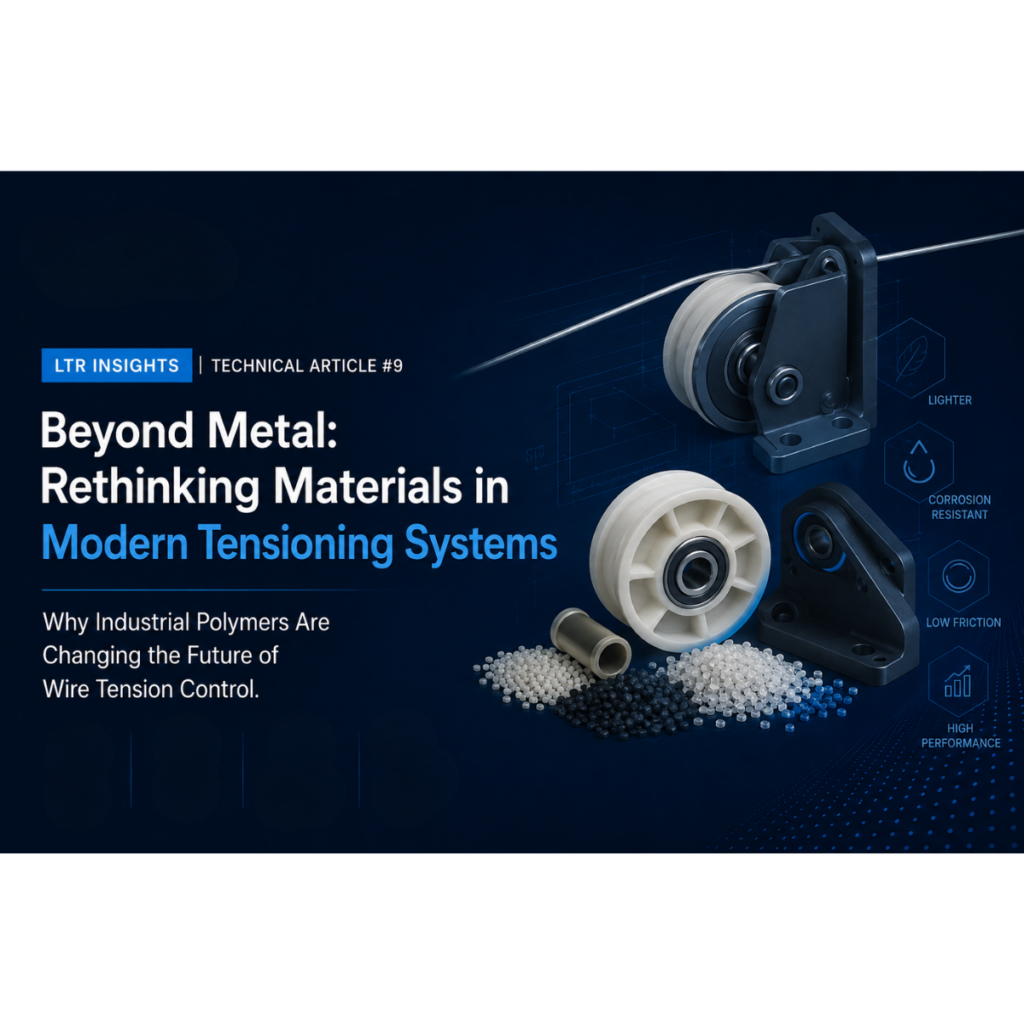
It is a reasonable question. However, it is increasingly based on an outdated perception of what industrial polymers are capable of achieving. Today, advances in material science and additive manufacturing are challenging traditional assumptions and opening new possibilities for the design of high-performance tension control systems.
The Origin of the “Plastic = Fragile” Perception
The idea that plastic components are inherently fragile comes largely from experience with consumer products, low-cost parts, and non-structural applications.
In industrial environments, however, not all polymers are created equal.
Modern engineering polymers are specifically formulated to provide:
- High impact resistance
- Excellent dimensional stability
- Resistance to oils and industrial chemicals
- Long-term mechanical reliability
Evaluating an industrial polymer using the same criteria applied to consumer plastics is like comparing structural aluminum with a disposable aluminum can. The material category may be the same, but the engineering purpose is entirely different.
Not All Polymers Are Created Equal
Among the most widely used engineering polymers is ABS (Acrylonitrile Butadiene Styrene), a material that combines rigidity, toughness, and processability.
Its unique molecular structure provides a balance between: strength and impact resistance, dimensional stability, lightweight construction and resistance to many industrial fluids.
For wire tensioning applications, these characteristics are particularly valuable because they allow the housing structure to maintain alignment while absorbing the small shocks and vibrations that naturally occur during operation.
Rather than being a compromise, industrial ABS can become a functional engineering advantage.
Why Weight Matters More Than People Think
When discussing tensioners, weight is rarely the first parameter that comes to mind. Yet it directly influences system dynamics.
A lighter structure can offer several benefits: reduced inertial loads, lower stress on supporting components, easier machine integration, improved handling during maintenance and, last but not least, greater design flexibility.
In modern winding equipment, where compact layouts and dynamic performance are increasingly important, reducing unnecessary mass can contribute to a more efficient overall system.
Sometimes, lighter is not weaker, it is simply smarter.
Vibration Damping: An Unexpected Advantage
One of the most overlooked differences between metal and polymer structures is their response to vibration.
Metal components tend to transmit and amplify vibration throughout the assembly. Engineering polymers behave differently. Thanks to their internal molecular structure, materials such as ABS naturally absorb part of the vibrational energy rather than transmitting it.
For tension control systems, this can provide several advantages:
- Reduced resonance effects
- Improved operational smoothness
- Lower noise levels
- Better protection of sensitive components
While vibration damping is rarely considered during material selection, it can have a meaningful impact on long-term system stability.
Additive Manufacturing Changes the Rules
The real innovation is not only the material itself, but also the way it can be manufactured.
Additive manufacturing allows engineers to rethink the entire design process.
Unlike traditional machining or die-casting, 3D printing enables: rapid prototyping and validation, customer-specific geometries, fast design iterations, lightweight internal structures, and also on-demand spare part production.
This flexibility allows tensioning systems to evolve faster and adapt more effectively to specific customer requirements.
Instead of forcing the application to adapt to the product, the product can adapt to the application.
Sustainability Beyond Marketing
Sustainability has become an important consideration in industrial manufacturing, but meaningful sustainability goes beyond simple environmental claims.
Additive manufacturing contributes to sustainability by: using material only where needed, minimizing production waste, reducing machining operations, lowering transportation requirements through local production, supporting on-demand manufacturing models.
Furthermore, ABS is a recyclable thermoplastic material, allowing components to be reprocessed at the end of their service life.
The result is a more efficient use of resources throughout the product lifecycle.
Engineering Insight
When comparing industrial polymers with traditional metallic materials, the discussion should focus on application requirements rather than assumptions.
The objective is not to replace metal everywhere. The objective is to select the material that delivers the best overall performance for the intended application.
Conclusion
The question is no longer whether an engineering polymer can replace a metal component.
The real question is whether traditional materials are always the best solution for modern manufacturing challenges.
Advances in material science and additive manufacturing are enabling lighter, smarter, and more adaptable tension control solutions, without compromising performance, reliability, or durability.
As winding processes continue to evolve, engineers must be willing to evaluate materials based on measurable performance rather than long-established assumptions.
At LTR Winding Innovations, we continuously explore new materials and manufacturing technologies to develop innovative tension control solutions for electrical wire and textile yarn applications, helping manufacturers improve efficiency, flexibility, and long-term process reliability.