
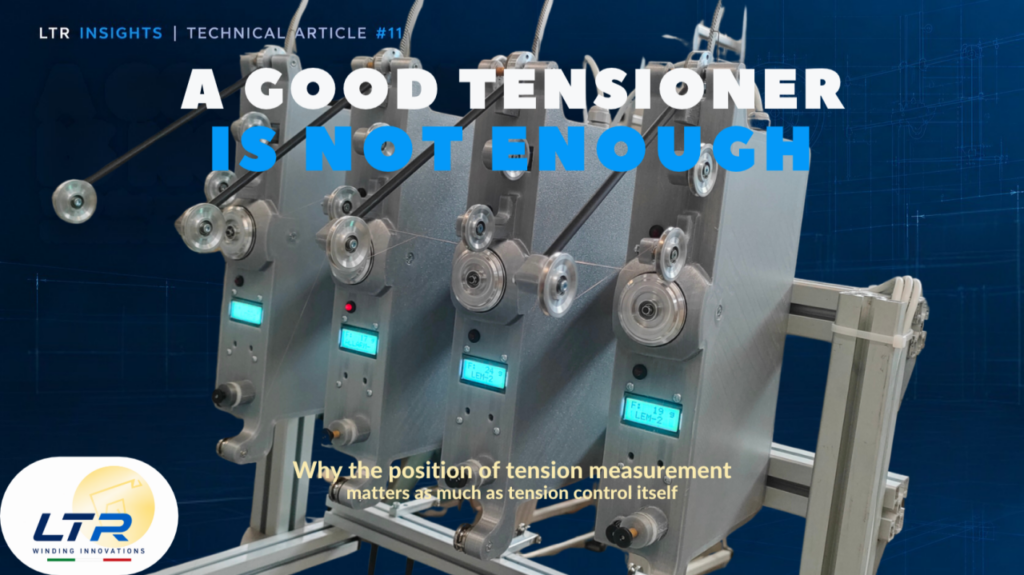
Article #11
21 October 2026
Why the position of tension measurement matters as much as tension control itself
In a winding process, choosing the right tensioner is essential. But it is not enough. A tensioner can be correctly sized, properly adjusted and technically capable of maintaining stable tension, while the wire reaching the winding point still experiences a different tension from the one we expect. Why?
Because between the tensioner and the winding point, the wire interacts with the machine.
Every pulley, guide, eyelet, deviation and change in direction can influence the final tension. This means that good tension control does not depend only on how tension is generated, but also on where tension is measured.
The Tensioner Is Only One Part of the System
In theory, the process seems simple:
Spool → Tensioner → Winding Point
In reality, the wire path is often much more complex:
Spool → Tensioner → Pulley → Guide → Eyelet → Deviation → Machine Guide → Winding Point
Each of these elements introduces mechanical interaction with the wire. Friction, contact angles, pulley conditions, alignment and wire-path geometry can all modify the tension between one point and another.
Therefore:
Tension at the tensioner ≠ necessarily tension at the winding point
And this difference can become particularly relevant when the process requires high repeatability or works within narrow tension tolerances.
Every Contact Point Can Change the Tension
Whenever a wire changes direction or comes into contact with a mechanical element, additional forces are introduced into the system.
The effect may be small at a single point. But winding machines often contain several contact points between the tensioner and the final winding area. Their combined effect can become significant.
The final wire tension can be influenced by:
- Pulley friction
- Guide geometry
- Contact angle
- Bearing condition
- Contamination or wear
- Wire surface characteristics
- Machine alignment
- Acceleration and deceleration
- Dynamic changes in the wire path
This means that even a perfectly functioning tensioner cannot compensate for something it does not measure.
Where Should Tension Be Measured?
If the objective is to understand the tension that actually affects the winding process, the measurement point becomes critical.
Ideally, tension should be measured as close as technically possible to the point where the wire enters the winding process. Why?
Because the closer the measurement is to the winding point, the fewer uncontrolled mechanical elements remain between the measurement and the process itself.
This provides a more representative value of the actual tension experienced by the wire during winding.
The principle is simple:
Measure the process where the process actually happens.
Upstream Measurement vs. Process Measurement
Imagine a tensioner producing a nominal tension of 500 g.
If tension is measured immediately after the braking system, the reading may correctly indicate approximately 500 g. But after the wire passes through several pulleys and guides, the tension reaching the winding point may be different.
The problem is not necessarily the tensioner.
The problem is that the measurement does not include everything that happens downstream.
This distinction is particularly important in closed-loop systems.
A closed-loop controller can only correct the variable that its sensor actually measures. If the load cell is positioned upstream of several mechanical disturbances, the control system may maintain excellent stability at the sensor while the actual winding tension is still changing.
Closed Loop Is Only as Good as Its Feedback
In an electronic tension control system, the load cell provides the feedback used by the controller.
The basic principle is:
Set Point → Control → Wire → Load Cell → Feedback → Correction
If the measured tension differs from the set point, the system adjusts the braking force accordingly.
But the quality of this control depends on the quality and relevance of the feedback signal.
This leads to an important principle:
A closed-loop system does not automatically guarantee control of the tension at the winding point. It guarantees control of the tension at the point where the system measures it.
The distinction may appear subtle, but from a process engineering perspective it is fundamental.
The Wire Path Is Part of the Tension-Control System
For this reason, tension control should not be considered as an isolated component of the machine.
The complete system includes:
Unwinding + Tensioner + Wire Path + Measurement + Winding Process
Changing one of these elements can change the behaviour of the entire system.
A new pulley.
A different guide angle.
A worn bearing.
A modified machine layout.
A different wire diameter or surface.
Any of these can influence the tension reaching the winding point.
This is why analysing the complete wire path is often just as important as selecting the correct tensioner.
Engineering Insight | Measure What Matters
From a process-control perspective, the most useful variable is not necessarily the tension generated by the tensioner. It is the tension that actually reaches the process.
We can express this concept in a simplified form as:
T_process = T_tensioner + ΔT_wirepath
where:
- T_tensioner = tension generated or controlled by the tensioner
- ΔT_wirepath = total effect introduced by the mechanical path between the tensioner and the winding point
Depending on friction, geometry and dynamic conditions, this contribution may vary during the process.
Therefore, if we want to control T_process, we should measure it as close as possible to the process itself.
From Component Control to Process Control
This represents an important change in perspective.
Traditional tension control often focuses on the component:
“Is the tensioner correctly adjusted?”
A more advanced approach asks instead:
“What tension is the wire actually experiencing when it enters the winding process?”
The first question evaluates the device. The second evaluates the process.
And ultimately, winding quality depends on the second.
Conclusion
A good tensioner is essential. But a good tensioner alone cannot guarantee a good winding process.
The tension experienced by the wire depends on the complete path between the supply spool and the winding point.
For this reason, correct tension control requires not only the right braking technology, but also:
- A properly designed wire path
- Correct positioning of the measurement system
- Reliable load-cell feedback
- A control strategy based on the tension that actually reaches the process
This is also the principle behind LTR electronic tension-control systems.
LTR tensioners use an automatic learning procedure for load-cell calibration, allowing the system to establish a reliable relationship between the sensor signal and the actual wire tension.
Combined with the correct positioning of the load cell within the wire path, this allows us to determine and control the actual wire tension at the entrance of the winding process, rather than simply relying on the theoretical tension generated by the braking system.
Because in precision winding, the most important value is not the tension we think we are applying. It is the tension the wire is actually experiencing.