
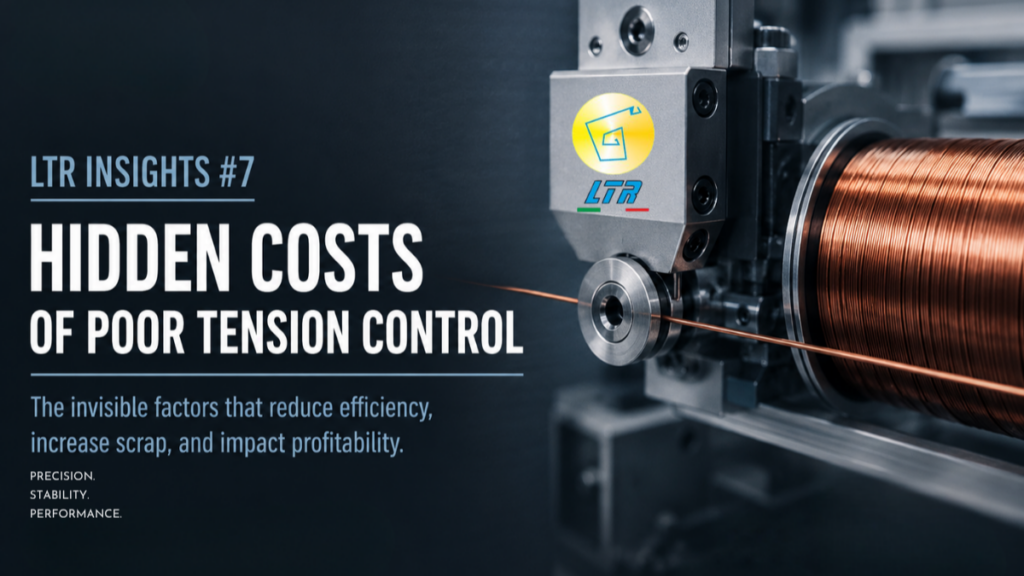
The Invisible Factors That Reduce Efficiency, Increase Scrap, and Impact Profitability
Article #7
12 May 2026
In many winding operations, poor tension control is associated only with obvious issues such as wire breaks or defective coils.
But the real impact is often much broader, and far more expensive.
The most significant costs generated by unstable tension are usually hidden inside the process itself: reduced efficiency, inconsistent quality, operator dependency, unplanned downtime, and material waste that slowly accumulates over time.
And because these losses are rarely measured directly, they are often accepted as “normal production variability.”
The Problem with Invisible Losses
Unlike a machine failure, tension instability rarely stops production immediately.
Instead, it creates small deviations that gradually affect the entire process:
- Slight variations in winding density
- Inconsistent layer distribution
- Increased friction and mechanical wear
- Unstable downstream processing
- Variable product quality from batch to batch
Each individual issue may seem minor. Together, they can generate significant economic losses over weeks and months.
Scrap Is Only the Visible Part
When companies evaluate the cost of poor tension control, they usually focus only on:
- Broken wire
- Defective coils
- Rejected products
However, scrap is often just the final symptom of a deeper instability.
The hidden costs frequently include:
- Machine stops and restarts
- Operator intervention time
- Additional quality inspections
- Rework operations
- Lower production speed for stability reasons
- Premature wear of pulleys, pads, and mechanical components
In many cases, the indirect costs exceed the material loss itself.
Operator Dependency: An Unstable Variable
In manual or mechanically adjusted systems, tension quality often depends heavily on operator experience.
Two operators may set the same nominal tension, yet achieve completely different process conditions.
This creates:
- Inconsistent production repeatability
- Longer setup times
- Variability between shifts
- Higher training requirements
As production speeds increase and tolerances become tighter, this dependency becomes increasingly difficult to manage.
The Cost of Process Instability
Even small tension variations can produce measurable effects throughout the winding process.
Examples include:
- Non-uniform bobbin geometry
- Unstable braiding or insulation application
- Irregular electrical properties
- Deformation of fine wire
- Vibration at high speed
These effects reduce process reliability and force manufacturers to compensate through:
- Slower production speeds
- Conservative machine settings
- Wider quality tolerances
The result is lower overall efficiency.
Hidden Energy and Material Waste
Poor tension control also impacts sustainability and resource consumption.
Unstable processes typically generate:
- Higher copper and aluminum waste
- Unnecessary yarn consumption
- Repeated startup losses
- Additional machine running time
In high-volume production environments, even small percentage losses can translate into substantial annual costs.
As raw material prices continue to rise, tension stability becomes not only a technical issue but an economic and environmental one.
From Reactive Corrections to Predictive Control
Traditional systems often react to problems only after defects appear.
Modern electronic tensioning systems change this approach completely.
Through real-time measurement, closed-loop correction, data logging and trend analysis manufacturers can identify instability early and maintain a controlled, repeatable process.
The objective is not simply to reduce defects but to eliminate the hidden causes behind them.
Engineering Insight
From a process engineering perspective, poor tension control increases overall process variability.
Reducing tension instability directly improves total process consistency, enabling tighter tolerances and more predictable production outcomes.
Conclusion
The true cost of poor tension control is rarely limited to scrap alone.
Hidden inefficiencies, including downtime, variability, reduced speed, operator dependency, and premature wear, often have a much greater long-term impact on productivity and profitability.
Understanding these hidden costs is the first step toward building a more stable, efficient, and data-driven winding process.
At LTR Winding Innovations we help manufacturers transform unstable winding processes into controlled, repeatable, and data-driven production systems through advanced wire and yarn tension control technologies.